This post may contain affiliate links. Please read our disclosure policy.
Setting up a kitchen for one takes just a few right-sized pans, baking dishes, and a small set of tools, whether you’re stocking a first kitchen or cooking for yourself for the first time. This list covers what you actually need to make single serving meals, and what you can skip.
A Note From Joanie
Setting up a kitchen for one can feel like a big undertaking, especially if you’re doing it for the first time, or doing it again after years of cooking for other people. I want you to know it’s simpler than it looks.
I hear from readers in all kinds of situations: students in a first apartment, young professionals stocking a kitchen from scratch, and people newly on their own who are rethinking a kitchen that used to feed a family. Wherever you’re starting, you deserve good meals made just for you, not the same leftovers night after night.
Cooking for yourself is worth the effort. Start with a couple of easy recipes and build from there, like my Baked Chicken Breast, Cheesy Baked Eggs For One, and Fluffy Pancakes For One.
Why The Right Size Matters
When you’re cooking for one, the size of your pans and dishes matters more than how many you own. A single serving spread across a dish built for a family cooks differently. The food sits thin and shallow, so it bakes faster and can dry out before the timer says it should. Match the dish to the amount of food and it cooks the way the recipe intends.
That’s why this list is built around a few right-sized pieces instead of a full cabinet of cookware. If you’re setting up a first kitchen, you can start small and skip most of what the big checklists tell you to buy. And if you’re rethinking a kitchen that used to feed a whole family, you probably don’t need more gear. You just need a few smaller dishes that fit how you cook now.
Every recipe on One Dish Kitchen lists the exact pan or dish size we tested it in, so the sizes below aren’t random. They’re the ones that actually come up when you cook single serving meals. And if you ever want to shrink a larger recipe to fit one of these dishes, our guide on how to reduce a recipe walks through the sizing and the measurements.
The Bare Minimum To Start
To cook most single serving meals, you need about six pieces of equipment, not a full cabinet. Here’s the starter set that gets you cooking for one:
- 10-inch skillet: Handles most stovetop cooking for one, from a protein and vegetables together to a stir fry, and an ovenproof one lets you start on the stove and finish in the oven.
- 1-quart saucepan: The right size for one portion of pasta, rice, oatmeal, or soup, without a big pot half full of water.
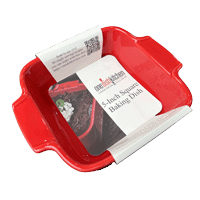
- A 5×5-inch baking dish: The workhorse for single casseroles, baked mains, and a lot of desserts. Our recipes also use a 5×7-inch dish and a 10-ounce ramekin to round out the set, both covered in the bakeware section below.
- Chef’s knife and paring knife: Two knives cover nearly every prep job. Skip the big block set when you’re starting out.
- Cutting board: One sturdy board with room to work. Wood or thick plastic both hold up.
- Measuring cups and spoons: Small amounts need accuracy, so a basic set matters more when you’re cooking for one than for a crowd.
Cookware For One
These are the pots and pans we reach for most when cooking single serving meals. Each one lists the size we use and a few recipes it makes, so you can see exactly what you’d cook in it before you buy.
10-inch skillet (must-have)
The pan I reach for most. The extra surface area means you can cook a protein and vegetables together without crowding, and an ovenproof one moves from stovetop to oven. We use it for Pork Stir Fry For One, Swedish Meatballs For One, and Orange Chicken For One.
1-quart saucepan (must-have)
The right size for one portion of pasta, rice, oatmeal, or sauce. We use it for Mac and Cheese For One, Cheese Grits For One, and Alfredo Sauce For One.
8-inch skillet (nice-to-have)
Useful for smaller jobs like eggs, grilled cheese, or a single chicken breast, where the 10-inch is more pan than you need. We use it for Chicken Spaghetti For One, Chicken Margherita For One, and BBQ Shrimp For One.
2-quart saucepan (nice-to-have)
Better for soups and stews that need a little more depth than the 1-quart holds. We use it for Lentil Stew For One, Zuppa Toscana For One, and Chicken and Dumplings For One.
6.5-inch cast iron skillet (nice-to-have)
Holds heat well for searing and gives baked goods a crisp edge. It moves from stovetop to oven easily. We use it for Small Batch Cornbread, Ham and Cheese Dutch Baby For One, and Pork Tenderloin For One.
Bakeware For One
Every baking recipe on One Dish Kitchen that uses a baking dish or ramekin is made in one of just three sizes. Stock these three and you can bake anything on the site, from casseroles to cakes. A muffin pan and a baking sheet round out the rest.
5×5-inch baking dish (must-have)
The workhorse, good for single casseroles, baked mains, and a lot of desserts. We use it for Small Batch Lemon Bars, Mini Lasagna, and Mini Pecan Pie.
5×7-inch baking dish (must-have)
A little more room for when a recipe needs to spread out. We use it for Mini Texas Sheet Cake, Mini German Chocolate Cake, and Mini Detroit Style Pizza.
10-ounce ramekin (must-have)
Ideal for individual desserts, dips, and anything you bake and serve in the same dish. We use it for Lemon Meringue Pie For One, Deep Dish Chocolate Chip Cookie For One, and Blueberry Muffin For One.
Small muffin pan (nice-to-have)
For small batches of muffins and cupcakes. We use it for Small Batch Banana Muffins, Small Batch Vanilla Cupcakes, and Small Batch Morning Glory Muffins.
Rimmed baking sheet (nice-to-have)
Useful for scones, granola, cookies, and small sheet-pan meals. We use it for Small Batch Lemon Scones, Small Batch Butter Pecan Granola, and Small Batch Oatmeal Cookies.
Tools And Gadgets Worth Having
Beyond the pans and dishes, a small set of tools covers almost everything you’ll do in the kitchen. You already have your two knives, cutting board, and measuring cups and spoons from the starter set. These are the next pieces worth adding, the ones that earn a spot in the drawer instead of crowding it.
Everyday tools:
Mixing bowls: A small nesting set handles prep, mixing, and serving, and stores inside itself to save space.
Silicone spatula: For scraping bowls and pans clean and folding batter. A heat-safe one works on the stovetop too.
Whisk: A small balloon whisk for eggs, dressings, and smooth sauces.
Serrated knife: The natural third knife to add after your chef’s and paring knives, for bread and soft produce like tomatoes.
Small appliances, worth it if you cook or bake often:
Hand mixer: Makes quick work of cake batter, whipped cream, and anything you’d otherwise beat by hand.
Immersion blender: Purees soups right in the pot, so you’re not transferring hot liquid to a countertop blender.
Digital kitchen scale: Weighs pasta, portions, and baking ingredients, which matters more when the amounts are small.
What You Can Skip
The big kitchen checklists want you to buy dozens of items. Cooking for one, you’ll use a fraction of them. Here’s what you can leave on the shelf, whether you’re stocking a first kitchen on a budget or clearing out a kitchen that once held a family’s worth of gear.
Single-use gadgets: The avocado slicer, egg separator, garlic press, and spaghetti spoon each do one job that a knife, a spoon, or a pair of tongs already handles. They cost money and take up drawer space for the few times a year you’d reach for them.
Family-sized dinnerware and silverware sets: Sets built for 8 or 12 are made for a household. For one, a few place settings cover your meals, with a couple extra so you’re not washing up after every meal or caught short when someone stops by.
Big pots and roasting pans: A stockpot and a 9×13 roasting pan are built for volume you won’t cook. Your skillet, saucepans, and small baking dishes handle single servings without the storage headache.
Boxed cookware and knife sets: A 12-piece set looks like a deal, but most people use three or four pieces and store the rest. Buying the specific pans and two or three knives you’ll actually use costs less in the end and saves cabinet space.
When you’re not sure about something, wait and buy it the first time a recipe actually calls for it.
Where To Buy Without Overspending
Equipping a kitchen adds up, but you don’t have to buy it all at once, and you don’t have to pay full price.
Start with the sizes that are hard to find. The right-sized pans and dishes for one, especially the 5×5 and 5×7 baking dishes and the 10-ounce ramekin, can be tough to track down in stores that stock family-sized cookware. We carry the exact pieces we use on our Store page, so you can get the sizes the recipes are written for. You can also look for those same sizes at home and kitchen stores, thrift shops, and on Amazon.
Buy as you go. You don’t need a full kitchen on day one. Start with the must-haves, then add a piece the first time a recipe calls for it. You’ll end up with tools you actually use instead of a drawer full of guesses.
Check thrift and discount stores. Cast iron, stainless steel, and small baking dishes hold up for years, so gently used pieces are a smart buy. Discount stores are also a good place to find single pans and dishes without committing to a boxed set.
Time it with sales. Kitchen gear tends to go on sale after the holidays in January and again in late summer for back-to-school, when small-space and single serving pieces are easiest to find.
Ask around. Parents, grandparents, and friends often have extra pans, dishes, and tools they’d happily pass along, which helps most when you’re stocking a first kitchen on a tight budget.
Frequently Asked Questions
A 5×5-inch baking dish is the most useful size for cooking for one, right for single casseroles, baked mains, and many desserts. A 5×7-inch dish covers recipes that need a little more room. Every baking-dish recipe on our site uses one of those two sizes or a 10-ounce ramekin.
No, you don’t need an air fryer to cook for one, but it’s one of the more useful small appliances if you often cook proteins like pork chops, chicken, or steak. It cooks fast and cleans up easily. We have a number of air fryer recipes sized for one if you decide to get one.
Start by cutting the recipe in half, which often works as a first step. Halving again to reach a single serving can throw off the texture, since ingredients like eggs and leaveners don’t shrink evenly. Match your pan to the smaller amount as you go, because a dish that’s too big will overcook the food. This is why we build our recipes from the ground up for one, with the baking dish size treated like an ingredient. Our guide on how to reduce a recipe walks through it.
Setting up a kitchen for one is easier than the long checklists make it look. Start with the right-sized pans and a few good tools, add pieces as your cooking grows, and you’ll have everything you need to make real meals for one. When you’re ready to cook, our single serving recipes are all built for exactly the dishes on this list, and you can find the tested sizes on our Store page.
Especially for those pondering a first kitchen, single-purpose utensils (i.e., spaghetti serving spoon – which has never worked for me anyway) are NOT a good idea. The ubiquitous, use-it-for-everything kitchen tongs (I’ve got 3 of these, 2 stainless steel and 1 silicon-clad, all different sizes) are as functional for serving spaghetti as for salads, veggies, and darn near anything else being cooked or served, except possibly mashed potatoes. Selling single-use objects is for profit, not furnishing a minimal kitchen.
There are both pros and cons to cooking single servings when one lives alone. On the pro side, there will be no endless, repetitious days of chili for breakfast, lunch, and supper. On the con side, unless one is satisfied with meals that require zero cooking (sliced apple dipped in peanut butter, anyone?), there will be a LOT of cooking – 2 or 3 meals per day (although I am sometimes willing to eat a bowl of Cheerios in order to avoid cooking, even though there are dishes to be washed, which is why the Goddess gave us dishwashers). Please don’t natter about freezing the leftovers to spread consumption over a longer period. Unless multiple stand-alone freezers live in the kitchen or the garage, or both, there will never be room for all of it; and if a single person fills up, say, an upright freezer, it will NEVER get emptied. Once the freezer is packed, even if it’s less than half the size of the fridge, one may not ever see the bottom or the back of the darn freezer again. Even compulsive application of freezer tape and magic markers (contents named and dated) is not a guarantee that packages will be consumed before acquiring freezer burn and excessive frost.
Oh, yeah. Don’t fall into the trap my late mother always chased: the idea that all you have to do is stuff the whole pot of chili into a single dish (or zipper bag) before freezing. At some point, separation into single servings is a necessity; before freezing is a far better choice than looking for a hacksaw to divide the frozen concoction without having the whole thawed mess stuck right back into the fridge instead of having each serving frozen separately. Been there, done both. That family pack of discounted chicken pieces or pork chops? That’s where the sandwich bags come into the equation. One piece goes into the sandwich bag, and 2, 3, or even 4 sandwich bags will fit into the quart bag. Still single servings, and should a guest arrive in time for dinner, just thaw 2 pieces.
Use zipper bags (even if you freeze your prize leftovers in bowls of some sort before transferring to the zipper bag). They come in quart and gallon size, so buy way more quart bags than gallons – although the gallon size works very well to protect open plastic bags of frozen veggies from freezer burn if enough air is squeezed out before zipping. And (again referencing Mom), frozen veggies are the best second choice after fresh; I have a very limited list of things I buy in cans, mostly because canned stuff is limp and sometimes slimy – and most cans hold more than a single meal’s worth.
I concede that after cooking for a family of 5 for over 20 years it took some practice as well as determination and math, of all things, to cook for myself only. Well, there’s always the good old WAG, an expert eye, or (gulp) the digital kitchen scale if the numbers aren’t cooperating. At least there’s nobody demanding I cook Brussels sprouts …
Hi Joanie, I was so thrilled to find your You Tube channel !! I have your cookbook but I LOVE watching you on your You Tube channel. Seeing you make cooking dishes look so easy inspires me to try different dishes instead of making the same meals repetitively. Thank you!
I was hoping to find your recommendations for an oven thermometer for an electric oven.
Please sende your choice….there are many choices on Amazon but not sure which ones are best.
This is the oven thermometer we use – https://amzn.to/3nBnPDe – You can find all of the products we use and recommend on our store page – https://store.onedishkitchen.com/
A couple of suggestions chicken fried steak, and gravy, swiss steak all for one or two servings.
Thank you, Gary. We will add them to our list of recipes to possibly work on.
This was my husband’s name and chicken fried steak was one of his favioite dishes.
Coincidence?
I am SO thankful for this site!!!!! I love to cook but don’t like having huge amounts of leftovers. Plus the Cajun recipes are a major bonus. Who knew you could make bengeits with crawfish. Nothing like combining two of my favorite foods in the whole world. And red beans and rice? Oh my, I think I am in recipe heaven!!!!
I don’t have any Ramekins so I will need to get some. How do I know what size? Right now I am into the cooking for one recipes.
Kathy, we list the size of the ramekins and baking dishes we use in each of our recipes. You can also take a look at the dishes we recommend on our bakeware and cookware pages.
I am so happy I found your website! I have struggled eating hot homemade meals since my husband passed five years ago. I don’t like wasting food & this is the first time in my life It’s been just me. So I am excited about finding your website! Thank You so much!
I’m so glad you found us, Vicki. I hope you find many new recipes you love.
Where can I get that small blue slow cooker that I’m seeing in some of your FaceBook videos?
Hi Evelyn, the blue slow cooker is made by Hamilton Beach and is called their “Party Crock”. I believe it has been discontinued. I use the 1.5-quart slow cooker in our new slow cooker recipes. This one can be found on our bakeware page.