This post may contain affiliate links. Please read our disclosure policy.
Cooking for one in college doesn’t take a full kitchen. Whether you’re in a dorm with just a microwave or setting up your first apartment, here’s how to feed yourself well all semester.

Quick Look
- Best for: College students cooking for one, in a dorm or a first apartment
- What you need: A microwave and a mini fridge, plus a few more tools once you have a kitchen
- Skill level: Beginner friendly
- Covers: Gear, grocery shopping, storage, building meals, and budget
- Read time: About 8 minutes
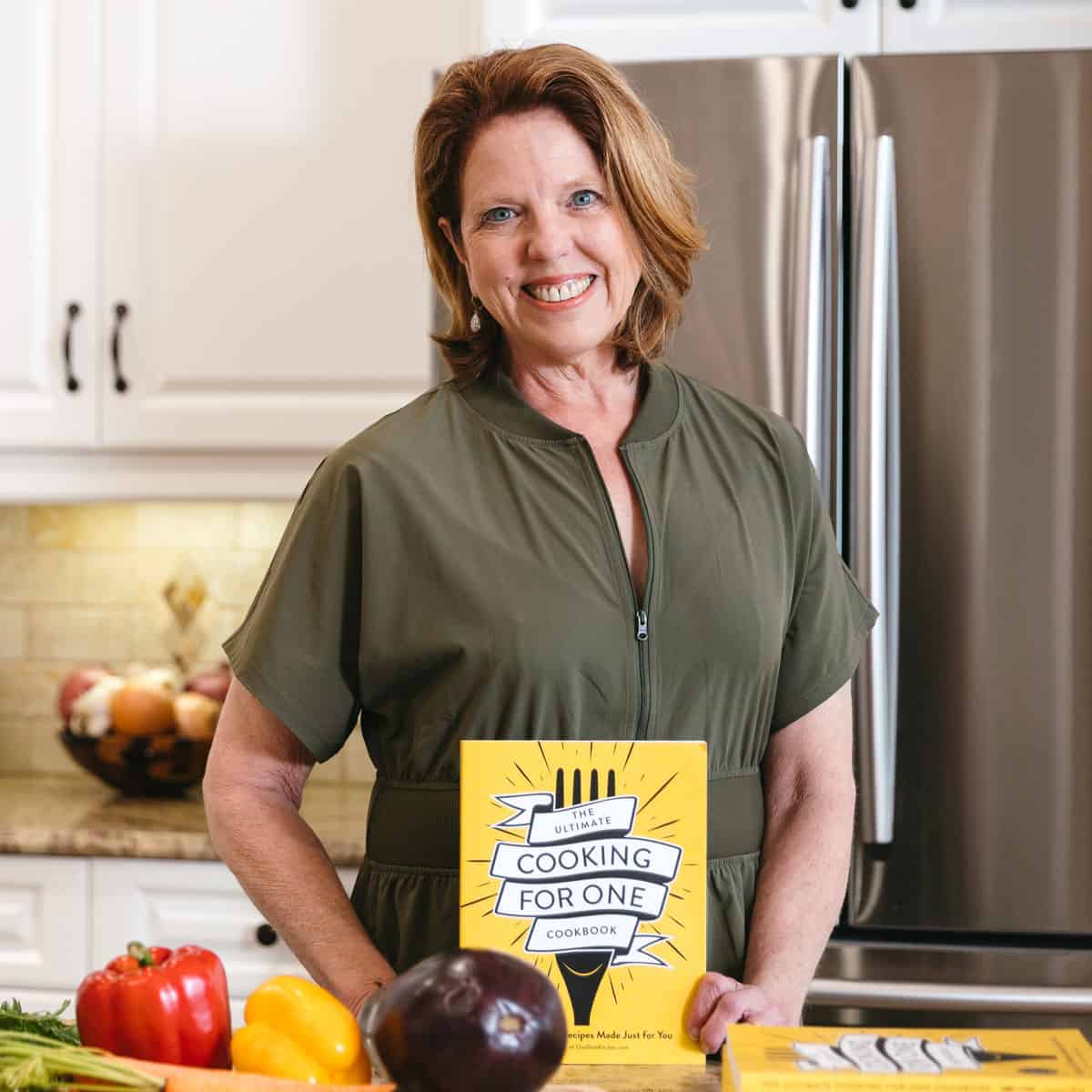
Cooking For One Started With My Son At College

One Dish Kitchen began with my son’s first year of college. He was living on packaged ramen and white rice almost every night. He wanted real food, but the recipes he found made enough to feed four, and cooking felt like more trouble than it was worth in a dorm.
So I started sending him recipes I sized for one person. I built each one from scratch so a single serving comes out right, since halving a family recipe rarely does.
That was 15 years and more than 700 recipes ago, all made from scratch and portioned for one from the start, tested until the amounts are right. I’ve spent that time solving the exact problem a student faces: how to eat well with a tiny kitchen, a small budget, and no leftovers.
The advice here is what actually works when you’re cooking for one in a dorm or a first apartment.
What You Need To Cook In A Dorm Or First Apartment
Your setup depends on where you live. A dorm allows you to have a microwave and a mini fridge, and that’s enough to make a lot of simple meals. A first apartment adds a stove, an oven, and room for a few more tools, which opens up almost everything else.
One thing to check before you buy: most dorms ban anything with an exposed heating element. Hot plates, toasters, toaster ovens, and air fryers are off-limits in nearly all dorm rooms. A microwave and an electric kettle are your safe bets. Read your housing rules first so nothing gets confiscated at move-in.
Also find out if your building has a shared kitchen. Many dorms have one on the floor or in the basement with a real stove and oven you can sign up for or use when it’s free. It’s the easiest way to cook a stovetop meal without keeping banned gear in your room.
In a dorm, start with:
- A large microwave-safe mug and bowl
- A plate and a small bowl
- A fork, spoon, and a small sharp knife
- A cutting board
- An electric kettle, if your dorm allows one
In a first apartment, add:
- One small skillet
- One small saucepan or pot
- A sheet pan
- A mixing bowl
- Measuring cups and spoons
- A small baking dish or two
That’s the whole list. You can cook for months on this before you need anything else. For a closer look at setting up a first kitchen, see my guide to kitchen essentials for one. And once you’re in a place that allows one, an air fryer is one of the most useful appliances for a single cook.
Grocery Shopping On A College Budget
Groceries are where cooking for one gets tricky. Most packages are sized for a family, and in a dorm your fridge is tiny and there’s barely any freezer. What you buy depends a lot on where you live and what you can actually cook.
In a dorm
Be honest about your setup. In most dorm rooms you’re not really cooking, you’re reheating and assembling with a microwave and a mini fridge. So shop for food that works that way. If your building has a shared kitchen, that’s where any real stovetop cooking happens.
Shop for a few days at a time, not a whole week. A mini fridge fills up fast, and food you can’t see gets forgotten and thrown out.
Keep a short list on your phone before you go. It gets you in and out and keeps you from grabbing things you have no room for.
Buy grab-and-go and no-cook items that store small: Yogurt, cheese sticks, hummus, deli meat, bread, fruit, and microwave-ready rice or oatmeal cups.
Buy vegetables pre-cut when your store sells them that way. Pre-cut peppers, carrots, or a small salad kit give you vegetables with no prep and nothing left to go soft.
For anything you heat up, try the frozen section. A small bag of frozen vegetables, or pre-cooked frozen chicken or shrimp, heats up in the microwave in minutes. Pre-cooked proteins also skip the food-safety worry when a microwave is all you have.
Watch your budget where it’s easy. Buy store brands for your basics, lean on cheap staples like oats, peanut butter, and bananas that keep you full between classes, and split the big stuff with your roommate, a mini fridge, a warehouse pack, a shared bag of rice, so it all goes further.
Once you have an apartment
A real fridge, freezer, and stove change everything. Now you can shop for the week, buy raw ingredients, and cook from scratch.
Take inventory before you shop. Look at what’s already in your pantry, fridge, and freezer, and build your next few meals around what needs eating soon.
Shop the bulk bins for grains, pasta, and spices. You scoop the exact amount you need, and it’s the cheapest way to try a new spice without a whole jar going stale.
Use the salad bar for small amounts of fresh vegetables. When you need a handful of spinach or a few mushrooms, grab just that much and skip the half-used bag.
Buy proteins one at a time at the butcher or deli counter, or buy a bigger pack and freeze it in single portions.
Keep costs down by thinking in cost per meal. A bag of rice, a dozen eggs, and a bag of frozen vegetables makes a week of dinners for a few dollars each. Cook around one ingredient too, like a roast chicken or a pot of rice stretched across a few meals, so nothing gets wasted.
I go deeper on all of this, including how to use the half of an ingredient you couldn’t avoid buying, in my guide on how to cook for one without wasting food.
Pantry Staples For College
A few basics on hand mean you can always put together something to eat, even the night before a grocery run. What belongs in your pantry depends on whether you’re working with a mini fridge or a full kitchen.
In a dorm
Your pantry is a shelf or drawer plus part of a mini fridge, so keep it small and no-cook. These store well and turn into quick meals and snacks:
- Microwave-ready rice and oatmeal cups
- Bread, tortillas, or bagels
- Peanut butter or another nut butter
- Nuts, granola bars, and trail mix
- Crackers and popcorn
- Canned tuna or chicken, and a can opener
- Shelf-stable fruit cups and applesauce
- Cheese and yogurt in the fridge
Once you have an apartment
With a stove and real storage, your pantry does more of the work. These keep for weeks or months and stretch across dozens of meals:
- Rice and pasta
- Canned beans and diced tomatoes
- Cooking oil (I reach for avocado oil, but any neutral oil works)
- Bouillon, for broth one cup at a time
- A few spices and a couple of seasoning blends
- Eggs, butter, and an onion or two
How To Store Food So It Lasts
Good storage is what keeps the food you bought from turning into money in the trash. How much you can do depends on your space, but even a mini fridge rewards a little effort.
In a dorm
Keep your mini fridge organized so nothing hides. Small bins or a Lazy Susan let you pull things forward and actually see what you have before it goes bad.
Store open snacks in sealed bags or containers. It keeps them fresh and keeps bugs out of a small room.
Eat the perishable stuff first. Yogurt, deli meat, and cut fruit go bad faster than shelf-stable items, so reach for those before the crackers and peanut butter.
Once you have an apartment
A real fridge and freezer let you store more and waste even less.
Freeze in single portions. Cooked rice, chili, soup, and sauces all freeze well. Portion them before they go in so you can thaw exactly one meal.
Label everything with the date. A piece of tape and a marker saves you from guessing what’s in a frozen container three weeks later.
Keep produce longer with a little care. Store onions and potatoes in a cool, dark spot, and keep them apart, since they spoil faster together. Wrap leafy greens in a paper towel to soak up extra moisture.
Freeze proteins in small pieces. Roll up bacon slices and freeze them so you can grab one or two at a time. Here’s how to freeze bacon in individual slices.
For more on making food last, see how to store food when you cook for one and how to freeze food for one.
Building A Meal Without A Recipe
Once you see the pattern, you can put together a meal without looking anything up. What that looks like depends on your kitchen.
In a dorm
Dorm meals are less about cooking and more about smart assembly. Pick something from each group and put them together:
- A base: a rice or oatmeal cup, bread, a tortilla, or crackers
- A protein: a pouch of tuna or chicken, deli meat, cheese, peanut butter, or yogurt
- A produce add-on: pre-cut veg, fruit, or a handful of spinach
Here are five you can build with little or no heat:
| Ingredients | Make or build |
|---|---|
| Tortilla + peanut butter + banana | A rolled-up peanut butter banana wrap |
| Yogurt + granola + fruit | A quick breakfast or snack bowl |
| Crackers + deli meat + cheese | A no-cook snack plate |
| Rice cup + pouch of tuna + pre-cut veg | A microwave tuna rice bowl |
| Tortilla + cheese + microwave | A quick quesadilla fold |
Once you have an apartment
With a stove, you can build almost any simple dinner from four parts:
- A protein: an egg, chicken, canned beans, tofu, or a handful of shrimp
- A carb: rice, pasta, bread, or a potato
- A vegetable: whatever’s fresh, or a scoop of frozen
- Something to bring it together: a sauce, cheese, or a drizzle of oil and a squeeze of lemon
Here are five you can cook with just a few ingredients:
| Ingredients | Make |
|---|---|
| Eggs + cheese + your favorite fillings | An egg wrap |
| Pasta + butter + garlic + Parmesan | Buttered noodles |
| Chicken + rice + black beans + corn + cheese | A chicken burrito bowl |
| Chicken + vegetables + soy sauce + rice | Chicken fried rice |
| Potato + cheese + butter + salt | Baked potato |
Once the four parts click, you stop needing a recipe for every meal. When you want to learn the building blocks, my basic recipes for one show you how to cook rice, chicken, potatoes, and simple sauces, and my guide on how to read a recipe step by step walks you through following one.
Easy Recipes To Start With
The tables above show how simple a meal can be. When you want more ideas with full amounts and steps, these collections are built for exactly this.
- My 31 easy college meals are quick, cheap, and sized for one, great once you have a stove or a kitchen to cook in.
- My 35 dinner ideas for one cover heartier dinners for a first apartment.
- And a meal plan for one takes the guesswork out of a whole week.
How To Cook In A Microwave
A microwave does more than reheat leftovers. With the one appliance almost every dorm allows, you can make a real meal or a quick treat. Here are six worth knowing.
Oatmeal. Stir 1/2 cup old-fashioned oats and 1/2 cup milk in a large bowl, bigger than you think, since it can bubble up. Microwave 90 seconds for a chewy bowl, adding 15 seconds at a time if you want it softer. Top with fruit, peanut butter, or a little brown sugar.
Scrambled eggs. Whisk 2 large eggs, 1 tablespoon whole or 2% milk, and a pinch of salt in a microwave-safe bowl or mug until combined. Microwave 30 seconds, then stir with a fork and add 2 tablespoons shredded cheese if using. Microwave until only a small amount of egg in the center is still liquid, about 30 seconds more. They finish cooking in the hot bowl, so pull them just before they look done.
A baked potato. Scrub a potato and poke it a few times with a fork. Microwave 5 minutes, flip it, then microwave 3 to 5 minutes more until it gives when you squeeze it. Split it open and top with butter, cheese, or whatever you have.
Steamed frozen vegetables. Put a handful of frozen vegetables in a bowl with a splash of water. Cover with a plate and microwave 3 to 4 minutes until tender. Drain, then add butter, salt, or a little soy sauce.
Rice. The easiest route is a microwave rice cup or pouch, ready in about 90 seconds. To cook it from raw, rinse 1/4 cup long-grain white rice in a strainer, then add it to a large microwave-safe bowl with 1/2 cup water and a pinch of salt. Microwave uncovered until most of the water is absorbed, about 6 to 8 minutes, then cover and let it sit 4 to 5 minutes until tender. Fluff with a fork.
A rice krispie treat. Melt 1/2 tablespoon butter with 1 cup mini marshmallows in a microwave-safe bowl or mug, about 20 to 30 seconds, until the marshmallows puff up. Stir until smooth, then stir in 1 cup crispy rice cereal until coated. Eat it right from the mug, or press it into a buttered dish to set. Here’s my full Rice Krispie treat for one.
Frequently Asked Questions
A microwave handles a lot more than reheating. You can make oatmeal, scrambled eggs, a baked potato, steamed vegetables, and rice with that one appliance. See the microwave section above for the exact amounts and times.
In most dorm rooms you can reheat and assemble food, but not cook the way you would on a stove. Standard dorms allow a microwave, a mini fridge, and usually an electric kettle, so meals are built around those. For real stovetop cooking, use your building’s shared kitchen if it has one.
Most dorms allow a microwave, a mini fridge, an electric kettle, and a coffee maker with an automatic shut-off. Hot plates, toasters, toaster ovens, air fryers, and anything with an open flame or exposed heating element are usually banned as fire hazards. Always check your specific housing rules before buying.
Buy small amounts and eat the most perishable food first. A mini fridge is tiny, so shop for a few days at a time, keep it organized so nothing hides in the back, and reach for yogurt, deli meat, and cut fruit before shelf-stable snacks. Use frozen vegetables and pre-cooked proteins for anything you won’t finish quickly, since they keep for months.
Start with one meal. Make scrambled eggs tomorrow morning, or a rice bowl tonight. Once you’ve fed yourself a few times, cooking for one stops feeling like a chore and starts feeling like something you’ve got handled.
For more on setting yourself up, my cooking for one resources cover everything from freezing to meal planning, and my start here guide is a good first stop if you’re new to cooking for one.